
Loading article cover…
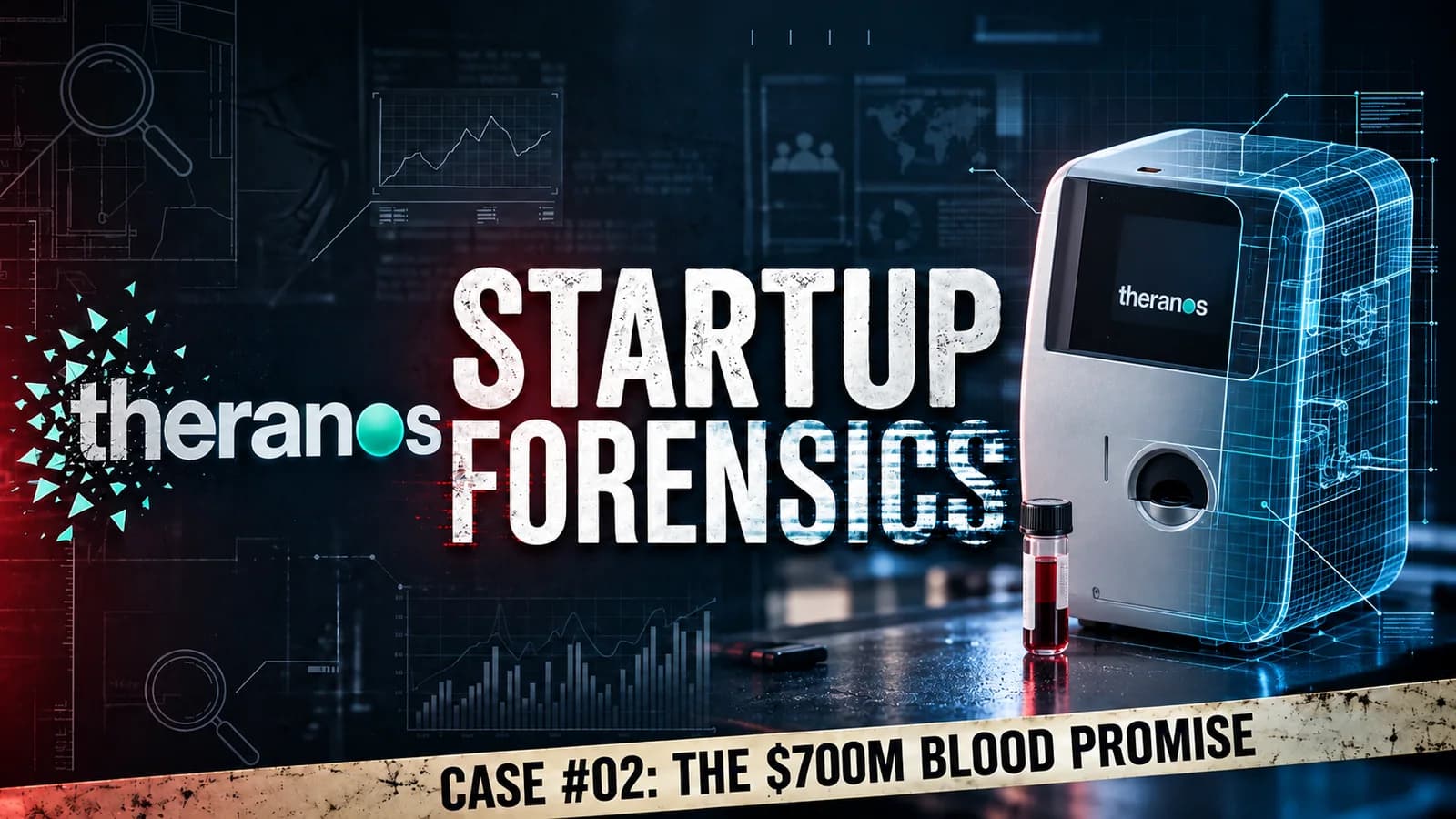
Startup Forensics: The Fall of Theranos
Theranos raised more than US$700m, by the SEC's account, on the promise of broad blood testing from a tiny sample. The SEC later charged the company and its leaders with fraud, and dissolution was announced in September 2018. Why Theranos failed is a story about claims that ran ahead of evidence, not only about money.[1] [5]
The SEC's account points to a specific gap: the analyzer performed only a small number of tests, and most patient tests used other manufacturers' commercial equipment. Our read: the claims ran far ahead of the evidence.[1]
The Patient: Theranos Funding and the Promise of Tiny-Sample Testing
Theranos promised broad blood testing from a tiny sample instead of conventional venous draws. If that worked, patients could be tested in very different places and ways. Investors bought into the promise in a big way. The SEC's 2018 complaint says the company raised more than US$700 million.[1]
Elizabeth Holmes led a company that wanted to turn a laboratory technology into a consumer-facing clinical service. The US$700m figure comes from the SEC's account. It is a record of capital raised, not a reconstruction of every financing instrument.[1]
- The promise: broad blood testing from a tiny sample instead of conventional venous draws.[1]
- Patients could be tested in very different places and ways, if the technology worked.[1]
- Total raised: more than US$700m, per the SEC. Lead-round investors are not verified.[1]
The Symptoms: The Theranos Warning Signs Were in the Analyzer Gap
Our read: the decisive crack was the gap between the proprietary analyzer and the claims used to attract capital. Outside equipment could not validate the advertised breakthrough.[1]
That gap should change how a board reads a demonstration. A successful result is not enough. Reviewers need the instrument identity, sample protocol, validation population, error distribution and any manual intervention. Without them, a conventional process can pass for proof that a new platform works. A customer willing to try the product tells you little about analytical accuracy.
- The SEC alleges investors were told 2014 revenue would exceed US$100m.[1]
- The SEC says the analyzer performed only a small number of tests.[1]
- Most patient tests used other manufacturers' commercial equipment, according to the SEC.[1]
Cause of Death: Why Theranos Failed When Claims Outran Evidence
Our read: the fatal flaw was that the claims ran far ahead of the evidence. The mechanism was not simply excessive burn. Investment and partnerships depended on claims that were materially disconnected from the underlying evidence.
Dissolution followed a loss of credibility. The Theranos shutdown was announced in September 2018, after the company had lost the credibility it needed to operate and finance its original promise.[5]
The regulators and partners moved first. In June 2016 Walgreens closed all 40 Theranos Wellness Centers in its Arizona stores, citing voided test results. In July 2016 CMS barred Holmes from running a lab for at least two years. The business lost its channels before the courts ruled.[8] [9]
Courts later judged the conduct, with limits. Holmes was convicted on four investor-fraud counts. She was acquitted on the patient-related counts, and the jury could not agree on three other investor counts. Balwani was convicted on all twelve counts in his trial. In February 2025, Holmes failed to overturn her fraud conviction on appeal. These verdicts establish conduct. They did not cause the earlier closure.[2] [3] [4]
The Toxicology Screen: The Numbers Behind Theranos's Collapse
Actual operating revenue was a little over US$100,000, according to the SEC. That compares a forecast with a result, and it comes from a civil complaint. It is not customer acquisition cost (CAC, the cost of winning one paying customer) or a clinical margin. Holmes and Theranos settled the SEC case without admitting or denying those allegations.[1]
Valuations and investment totals cannot replace an operating ledger. The Theranos burn rate reached about US$2m per week in 2013, per trial evidence reported by CFO.com, against zero revenue in 2012 and 2013. Theranos unit economics remain unpublished: no per-test contribution, no CAC, no user churn (the share of customers who leave) and no runway figure.[7]
- Customer acquisition cost (CAC): Not publicly disclosed. Per-test contribution and customer acquisition cost are missing from the records used here.
- User churn: Not publicly disclosed. The records used here give no share of users who stopped using the service.
- Pricing model: Not publicly disclosed. The records give no per-test price points, so the pricing model cannot be assessed.
- Monthly cash burn: Cash burn was about US$2m per week in 2013, per trial evidence reported by CFO.com. No monthly or later burn figure is published.[7]
- Runway at collapse: Not publicly disclosed. No cash balance is published, so runway before the September 2018 dissolution cannot be stated.
- Total funding: More than US$700m raised, per the SEC's civil complaint.[1]
- Peak valuation: Above US$9bn in 2014, per a contemporary Fortune report. This is a valuation, not capital raised.[6]
- Revenue: Zero in 2012 and 2013, per trial evidence reported by CFO.com. Slightly above US$100,000 in 2014, per the SEC.[1] [7]

Exhibit A. Figures, periods and uncertainty follow the cited records.
The Post-Mortem: Lessons for Founders
Require independent validation before calling a test proven. Before you change a claim from “in development” to “commercially proven,” require an independent validation package. Give a quality officer the authority to block a release when sample-level evidence is incomplete. A narrower launch delays revenue, but it stops a demo from turning into a clinical promise.
Tie every investor statement to a dated source. Use contracts, recognized revenue or validated specifications as the reference. Have someone outside the fundraising team check the reconciliation. Label forecasts and third-party equipment clearly. Inconvenient qualifications are cheaper than claims you cannot defend.
Further reading
- SEC, “Theranos, CEO Holmes, and Former President Balwani Charged With Massive Fraud,” 14 March 2018 (civil allegations and settlement)
- U.S. Department of Justice, “Theranos Founder Elizabeth Holmes Found Guilty of Investor Fraud,” 4 January 2022
- Reuters, “Embattled blood-testing firm Theranos to dissolve: WSJ,” 5 September 2018
More Startup Forensics teardowns: Why Bluelearn failed
Want a teardown like this every week? Subscribe to the Startup Forensics newsletter, or leave a comment telling us which startup we should investigate next.
Anshkosh Team
Written for the Anshkosh Journal
More from Startup Lessons
Startup Forensics: The Fall of Jawbone
Jawbone raised more than US$900 million and was valued at US$3.2 billion in September 2014, then liquidation was reported in July 2017.
Startup Forensics: The Fall of MoviePass
MoviePass ran an average monthly cash deficit of US$21.7m between September 2017 and April 2018.
Startup Forensics: The Fall of Juicero
Juicero raised a reported US$118 million to US$134 million (sources differ) and reached a reported peak valuation of US$270 million for a countertop press.